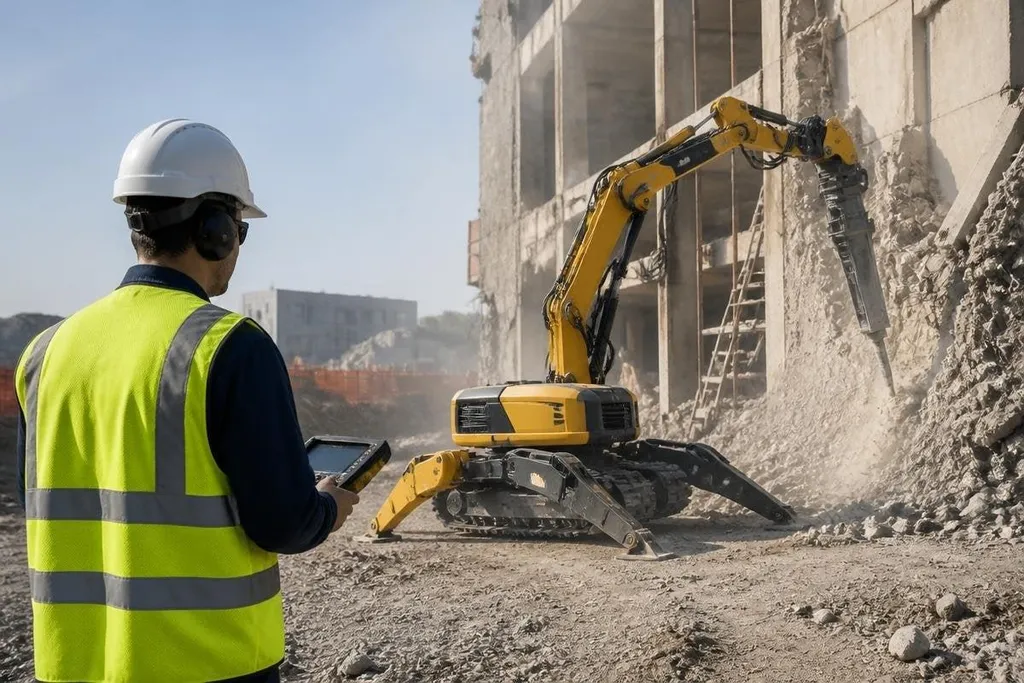
Construction sites put people near heavy loads, moving equipment, dust, noise, and changing ground. Robots can take on some of that work, but safety improves only when the task, machine, and work plan fit together.
Quick read
- Robots can keep people away from repeated lifting, cutting, drilling, and site inspection work.
- Remote control still needs a clear view, a safe stop, and a trained operator.
- A robot adds new risks around power, movement, software, and maintenance.
Start with the task, not the robot
A construction company should begin with a job that exposes workers to harm again and again. Repeated material movement, work at height, surface scanning, and work near unstable structures are useful places to look because the machine can take over a defined action.
That focus matters. A robot built for floor scanning won't solve the danger of lifting wall panels. A machine that carries materials may reduce manual handling while creating traffic risks around workers, vehicles, and stored supplies.
The safest plan gives the robot a narrow job with a clear result. The site team can then check where people stand, how the machine moves, what happens when it loses power, and who can stop it.
How robots reduce exposure
Remote operation is one direct path. An operator can control a machine from outside a dusty, loud, or unstable area, while cameras and sensors show the work zone. The operator still needs enough information to spot people, loose materials, edges, and changes in the ground.
Inspection robots can also collect images or other sensor data before a worker enters an area. That can help a team check concrete surfaces, tunnels, roofs, or damaged structures from a safer position. The value depends on the sensor view and the inspection plan. A camera cannot confirm a hidden fault that it cannot see.
Robotic tools may reduce repeated strain from drilling, cutting, fastening, or carrying. They don't remove the need for people. Workers still set up the machine, check the surface, manage materials, and decide whether the result is safe to accept.
Construction safety claims need a record of the machine, task, site, and human checks behind them. Robot24.com construction robotics coverage can put those details beside the hazards a robot may create. That record matters before the machine enters a live work area.
New machines bring new hazards
A mobile robot can strike a person if its route changes or its sensors miss an obstacle. A robotic arm can move with enough force to injure someone near its work area. Dust, rain, poor lighting, uneven ground, and signal loss can affect how the system behaves.
Construction sites also change during the day. Walls move, tools are left in new places, and several crews may share one space.
A map made in the morning may no longer match the site after lunch. The work plan needs a way to pause the robot, check its surroundings, and restart it safely.
Remote control has limits too. A screen can hide sound, distance, and small movement cues. Operators need a clear view, a reliable connection, and a stop control they can reach without delay. The company should set rules for who may enter the work zone while the robot runs.
The missing proof is often long-term site use. A short product video can show a machine completing one task. It doesn't show how the machine behaves after dust reaches its joints, a route changes, or a worker needs to stop the job in a hurry.
A practical safety check
Before putting a construction robot on a live site, check these points:
- Define the task: Write down the exact action, work area, and result the machine must produce.
- Mark the zone: Separate the robot's path from people, vehicles, stored materials, and exits.
- Test the stop: Confirm that the operator and nearby workers can stop motion quickly.
- Plan failures: Decide what happens after lost power, lost signal, blocked sensors, or a software fault.
- Train the crew: Show operators and nearby workers how the robot moves, pauses, and returns to work.
- Review each shift: Check the route, lighting, weather, surface, and nearby work before starting.
This check also helps a buyer compare machines without trusting a broad safety claim. Ask for the operating limits, maintenance needs, sensor coverage, training plan, and records from actual construction work. If those details are missing, the safety case is still unfinished.
I'd start with inspection or repeated material movement, where the task can be fenced off and measured. Construction robots will make sites safer when they reduce human exposure to a known hazard, and the next question is whether each job plan proves that reduction before the machine moves.